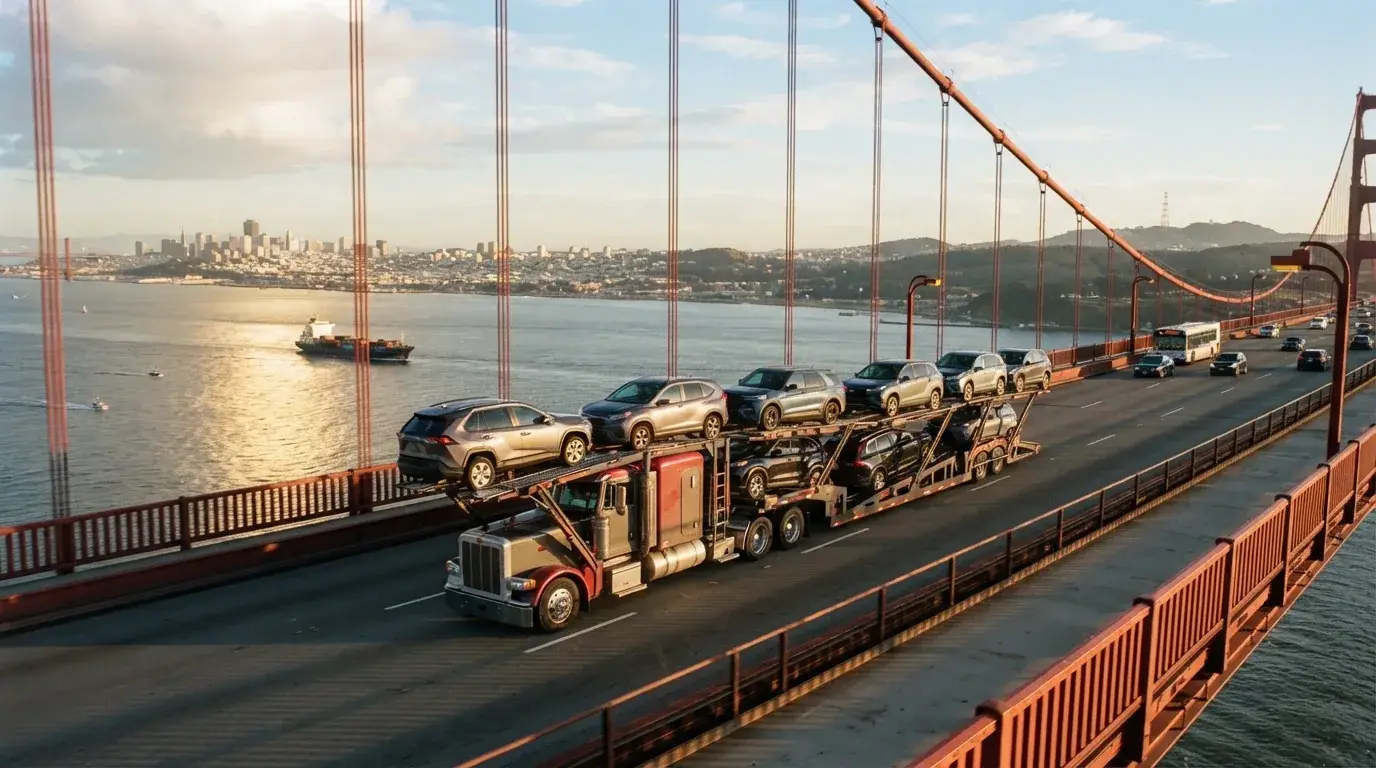
How much does it cost to ship a car? It comes down to the distance, the car's size and weight, an open or enclosed trailer, the season, how close both addresses sit to a main interstate, and whether the car runs. You'll hear the rate for your route on the call; every route page shows a planning range.
Longer trips cost more, but less per mile
A longer trip costs more in total, but each mile costs less. Loading, unloading and the miles a truck drives to reach your pickup cost about the same on a 300-mile run as on a 3,000-mile one, so on a long route that fixed part is spread thin. That's why a coast-to-coast move doesn't cost ten times a short regional one. Car shipping routes lists the planning range for each route on the site, and cross-country car shipping costs covers the long hauls in more detail.
Bigger and heavier vehicles take more of the trailer
A car hauler is limited by deck space and by weight. A midsize sedan is the baseline. A full-size SUV or a crew-cab pickup takes more of both, and a lifted truck may not fit the top deck at all. A heavy EV can price above a gas car the same size, and electric pickups price like the full-size trucks they are; electric vehicle shipping and heavy vehicle shipping cover both.
Open or enclosed
An open carrier moves seven to ten cars per trip, while an enclosed trailer carries far fewer, so each car on it covers a bigger share of the trip. That makes enclosed noticeably more expensive on the same road. It's the right call for a classic, an exotic or fresh paint; for a daily driver, open is the usual choice. Open or enclosed car shipping sets the two side by side.
The season, and which way you're going
Trucks fill fastest when everyone moves the same direction at once. Snowbirds head south in the fall and north in the spring, and summer is the busiest stretch for household moves, so rates on those roads climb in those weeks. Going against the main flow can price lower, because the carrier needs cars for the trip back. The best time of year to ship a car shows when the peaks fall.
Where the two addresses sit
A pickup a few miles off I-95 or I-10 fits into a truck's run with little detour. One two hours down a two-lane road costs the carrier half a day, and the rate reflects it. A tight street rarely adds cost by itself; meeting at a nearby lot solves it, as door-to-door or terminal car shipping explains.
A car that doesn't run
A non-runner needs a winch, and sometimes dollies or a forklift if the wheels won't turn. That takes a truck with the gear and extra time at both ends, so it adds to the rate. Non-running car shipping covers what the truck needs for each kind of car.
A flexible date or a fixed one
A pickup window of several days lets the car join a truck already headed your way. A fixed date narrows the choice to the trucks that can make it, and expedited vehicle shipping costs more because a truck has to be lined up for your date.
The details your rate is built on
- Both ZIP codes, or the full addresses
- Year, make and model, plus any lift, lowering or roof rack
- Whether it runs, rolls and steers
- Open or enclosed, if you already know
- Your first available pickup date and how flexible it is
With those in hand, the number you hear on the call fits your car and your road. To set it against the cost of driving, see car shipping by train, driving or truck.