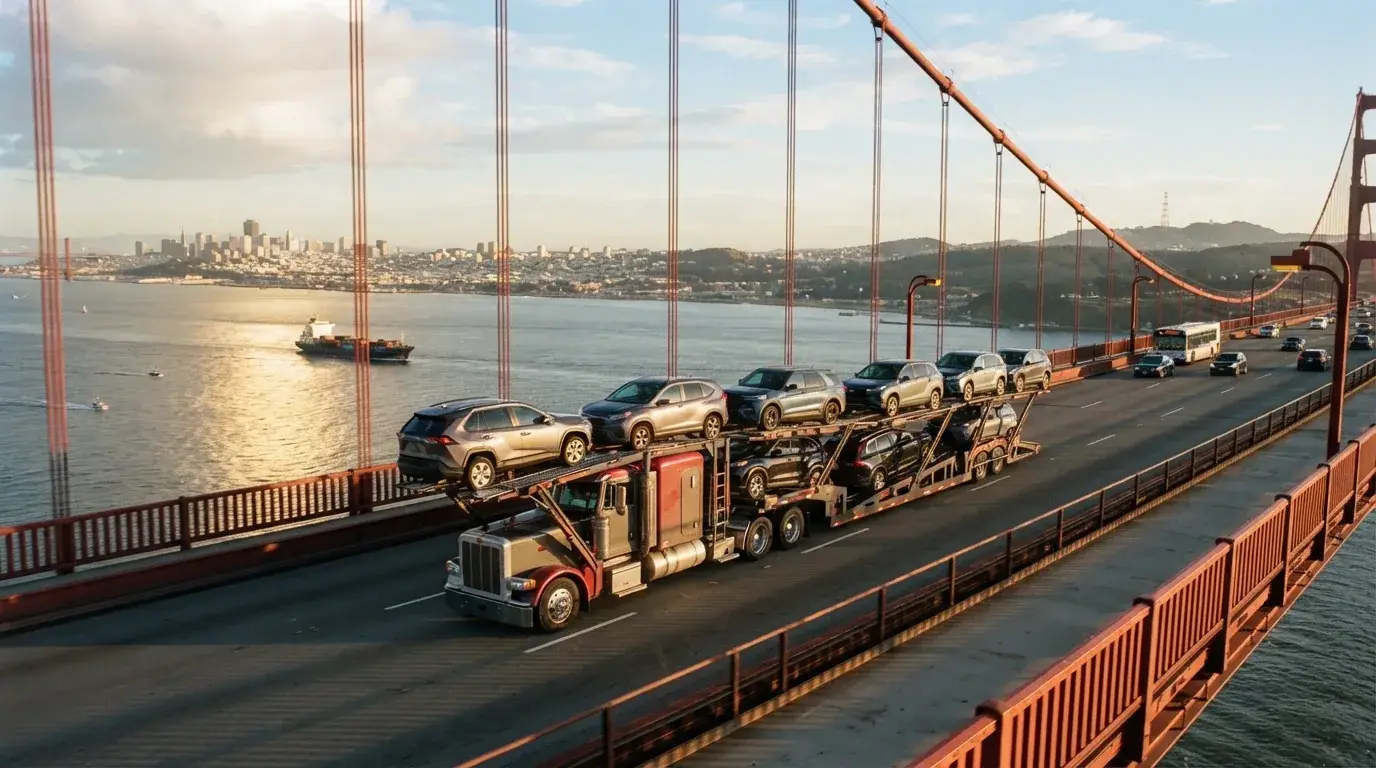
Car shipping by train is possible on one route only: Amtrak's Auto Train, which runs 855 miles between Lorton, Virginia and Sanford, Florida, and carries you along with the car. Everywhere else the choice is driving it yourself or shipping it on a car carrier, which picks the car up and delivers it at your door.
The Auto Train: one route, and you ride along
The Auto Train is an overnight passenger train. Your car goes into an enclosed auto rack at Lorton, south of Washington, DC, and comes off at Sanford, north of Orlando, the next morning, with no stops for cars in between. You travel on the same train and check in early in the afternoon. The car has to be a factory-standard vehicle within Amtrak's size limits; dually trucks and cars with gull-wing or scissor doors aren't accepted.
It suits a snowbird headed from the Northeast to Florida who would drive I-95 to Lorton anyway. Snowbirds who would rather not ride along ship the car down the same I-95 run with snowbird car transport. It doesn't help a move to Texas, Arizona or California, and it doesn't reach your door at either end. Freight trains do carry new cars from factories and ports, but they don't take private customers' cars.
What driving it yourself costs
Los Angeles to New York City is about 2,805 miles, roughly 40 hours behind the wheel. For one driver that's five or six long days, plus motels and meals. The IRS standard mileage rate for the second half of 2026 is 76 cents a mile, a figure meant to cover fuel, upkeep, insurance and depreciation; over that distance it comes to about $2,100 before the first motel. Only the fuel is paid on the trip itself; the rest is wear and value the car gives up.
Our planning range for the same trip on an open carrier is $1,100 to $1,500 for a sedan, with 7 to 10 days in transit (see Los Angeles to New York City car shipping). It's an estimate, not a quote, but it shows the scale.
Driving still makes sense when the move is a day or less on the road, or when you need the car the moment you arrive and can't plan around a delivery window.
When shipping is the better call
- The move is more than a day's drive, and your days off are worth more than the rate.
- You're flying, or a second driver would have to fly back.
- The car is a lease with a mileage cap, a classic that shouldn't pile on highway miles, or an EV on a route with thin charging.
- You're moving two cars and only one of you can drive; multiple car shipping puts both on the road together.
Driving, the Auto Train and a carrier side by side
| Driving | Auto Train | Car carrier | |
|---|---|---|---|
| Where it goes | Anywhere | Lorton, VA to Sanford, FL only | Between any two addresses a truck can reach |
| Door to door | Yes | No, station to station | Yes, or the nearest safe spot for the truck |
| Your time | About a day per 500 miles | An overnight trip plus check-in | Pickup, delivery and your own trip there |
| Miles on your car | All of them | Only the drives to and from the stations | None |
| You travel with the car | Yes | Yes | No |
Shipping the car on a move
On a move, the usual answer is to fly or drive one car and ship the other. Moving car shipping covers timing the car around the moving truck, and how long car shipping takes gives transit times by distance.